Why 'once a week' isn't always the right answer
A lot of general lawn-care advice defaults to weekly mowing, and for a lot of the growing season in Albany, that's a reasonable starting point. But grass growth rate isn't constant. It speeds up after warm, wet stretches and slows during dry spells or cooler weeks, even in summer. A schedule that ignores that ends up cutting too much off in fast-growth weeks and mowing an already-short lawn unnecessarily during slow ones.
The one-third rule matters more than the calendar
The standard guidance among turf professionals is to never remove more than about a third of the grass blade's height in a single mow. Cutting more than that at once stresses the grass, exposes more of the stem, and makes the lawn more vulnerable to heat stress, disease, and weeds moving into the thinned canopy. In practice, that means the right mowing interval is however often it takes to stay within that third, which changes with the weather, not the day of the week.
For most Bermuda and Zoysia lawns kept at a typical residential mowing height, that works out to roughly every 4–7 days during peak summer growth. Zoysia doesn't reliably need less frequent mowing than Bermuda; the two follow similar intervals. Centipede grows more slowly and can sometimes stretch toward 10 days between mows without exceeding the one-third rule, though a wet, warm stretch can shorten that for any grass type.
Rainfall changes the math as much as the calendar does
Southwest Georgia's summer rainfall pattern, periods of heavy rain followed by drier stretches, means growth rate swings during the season, not just between seasons. After a run of hot, rainy weeks, grass can need mowing closer to the 5-day mark even for slower-growing varieties. During a dry spell, stretching the interval is often the better call for the lawn's health, not just less work.
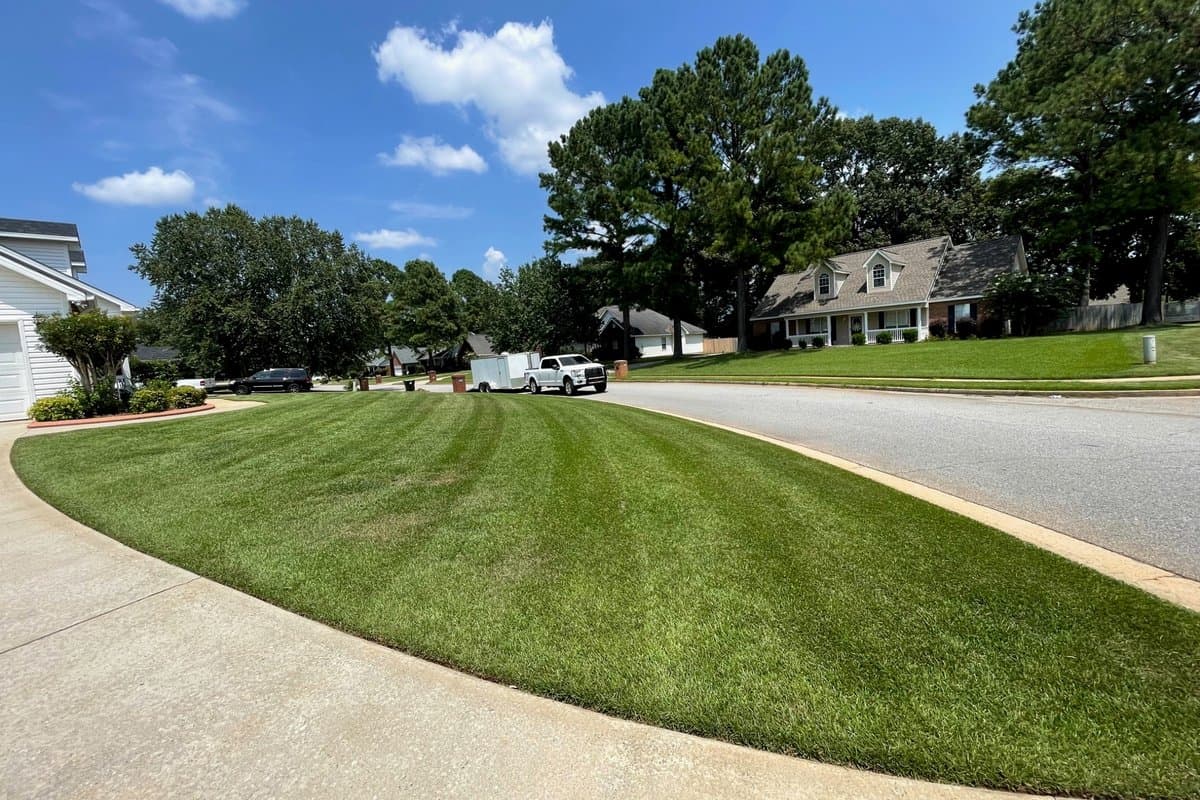
Consistent mowing height and pattern on a recurring-maintenance property.
Mowing height matters as much as frequency
Frequency and height work together. A lawn mowed too short forces more frequent cutting just to avoid removing too much blade at once, and it also stresses the grass and invites weeds by exposing more soil to sunlight. Bermuda is typically kept shorter than Zoysia or Centipede, but within each grass type, keeping height on the taller end of the recommended range during the hottest part of summer helps the lawn handle heat and drought stress better.
When a fixed recurring schedule still makes sense
None of this means a set schedule is a bad idea. It's just worth pairing with a bit of judgment. For recurring maintenance, weekly or biweekly scheduling can provide a useful framework, but actual cutting decisions should still follow growth, weather, turf type, and the one-third rule rather than running on autopilot regardless of conditions.